Reichenbachstraße 1 · 80469 Munich · at the Viktualienmarkt Office hours Mon–Wed 8:30–16:30 · Fri 8:30–15:00 Private and statutory health insurance · Tel. +49 89 24599075

Teeth grinding and clenching

Bruxism therapy in Munich

When your jaw cannot rest at night: causes, consequences and treatment options – including targeted injections into the chewing muscle.

Bruxism therapy – treatment of the masseter muscle at MKG-Praxis Dr. Hafner, Munich

What is bruxism?

When the jaw never rests

Bruxism means unconscious grinding or clenching of the teeth – at night during sleep (sleep bruxism) or during the day (awake bruxism). According to a systematic review, around 13 % of adults report frequent grinding at night, and 22 to 31 % report clenching during the day, depending on the study. Many people are unaware of it for a long time.

Typical signs include a feeling of pressure or tension in the jaw in the morning, headaches and neck pain, sensitive teeth, and clicking or grating in the jaw joint.

The causes vary: stress and tension are considered important triggers, while sleep disorders, certain medications, stimulants and the bite also play a role.

Possible consequences

A chewing muscle working overtime

The masseter is one of the strongest muscles in the body. In bruxism it is active even when nothing is being chewed – often unnoticed for years.

Teeth Wear and cracks

Enamel is worn away, teeth become sensitive and shorter, and in extreme cases cracks develop.

Restorations Fractures and loosening

Fillings, crowns, bridges and implant restorations are heavily loaded and may be damaged.

Jaw joint and muscles Pain

Constant strain can cause muscle pain, headaches, joint noises and restricted mouth opening.

Treatment

Injections into the chewing muscle

Treatment starts with a thorough examination of the teeth, jaw joints and chewing muscles. Depending on the findings, an occlusal splint, physiotherapy, relaxation techniques or a combination may be suitable.

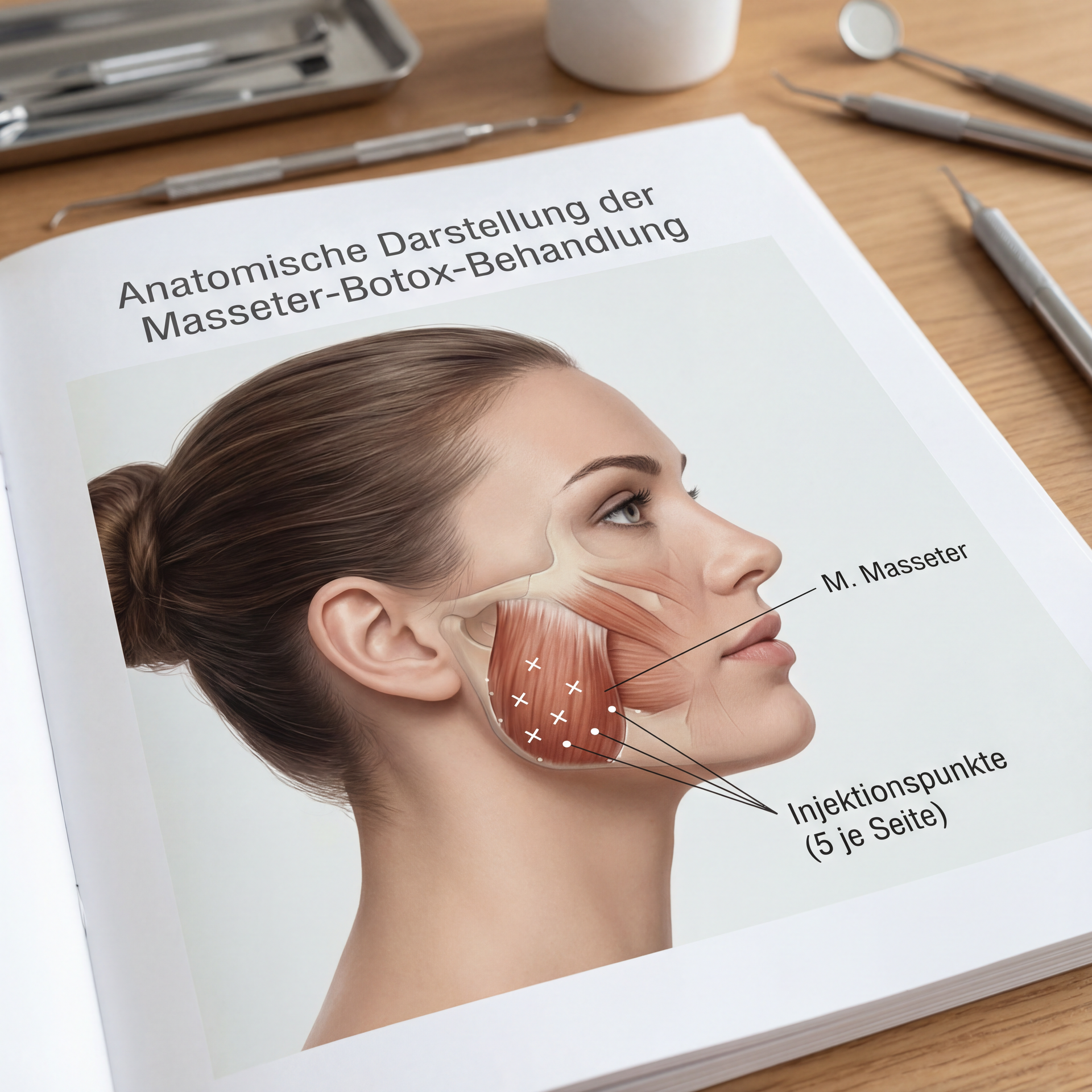
Another option is injecting botulinum toxin type A into the masseter muscle. It temporarily reduces signal transmission from nerve to muscle. The muscle is not paralysed but its force is dampened: chewing, speaking and facial expression are preserved.

The injections are given as an outpatient procedure with very fine needles at several points of the muscle; anaesthesia is usually not needed. The dose is determined individually. The treatment itself takes only a few minutes.

Botulinum toxin is not specifically licensed for the treatment of bruxism, so it is used off-label. We will explain this, possible side effects and alternatives to you in detail beforehand.

Typical course

  • After a few days The effect gradually begins and tension eases.
  • After about 2 weeks The full effect is reached.
  • 3 to 6 months This is how long the effect usually lasts.
  • If needed The treatment can be repeated.

The course varies from person to person. Treatment success cannot be guaranteed.

Good to know

Frequently asked questions

What side effects are possible?

They are usually mild and temporary: a feeling of pressure or small bruises at the injection sites and temporarily reduced chewing force. As the masseter may lose volume, the lower face can look slightly slimmer. Rarely, the substance can affect neighbouring muscles and, for example, temporarily change your smile.

When is the treatment not suitable?

We do not treat pregnant or breastfeeding women, children, people with certain neuromuscular disorders (such as myasthenia gravis, Lambert-Eaton syndrome or amyotrophic lateral sclerosis) or anyone allergic to components of the product. Certain medications can influence the effect – a careful medical history is therefore always part of the consultation.

What should I do after treatment?

You can return to your everyday activities straight away. On the day of treatment, avoid massaging the treated areas and intensive exercise.

What does the treatment cost?

Costs depend on the German fee schedule and the individual scope of treatment. You will receive a cost estimate in advance. Statutory health insurance usually does not cover the costs; private insurers may reimburse them depending on your policy and the medical indication.

Scientific background

What do studies show?

In controlled studies, injections of botulinum toxin type A into the masseter mainly reduced the intensity of muscle activity during grinding as well as pain and subjective symptoms. The frequency of bruxism episodes was not reduced in all studies. Reviews consider the treatment a possible option but point to small studies and limited evidence.

  • Lee SJ, McCall WD Jr, Kim YK, Chung SC, Chung JW. Effect of botulinum toxin injection on nocturnal bruxism: a randomized controlled trial. Am J Phys Med Rehabil. 2010;89(1):16–23. doi:10.1097/PHM.0b013e3181bc0c78
  • Shim YJ, Lee MK, Kato T, Park HU, Heo K, Kim ST. Effects of botulinum toxin on jaw motor events during sleep in sleep bruxism patients: a polysomnographic evaluation. J Clin Sleep Med. 2014;10(3):291–298. doi:10.5664/jcsm.3532
  • Ondo WG, Simmons JH, Shahid MH, Hashem V, Hunter C, Jankovic J. Onabotulinum toxin-A injections for sleep bruxism: a double-blind, placebo-controlled study. Neurology. 2018;90(7):e559–e564. doi:10.1212/WNL.0000000000004951
  • Shim YJ, Lee HJ, Park KJ, Kim HT, Hong IH, Kim ST. Botulinum toxin therapy for managing sleep bruxism: a randomized and placebo-controlled trial. Toxins (Basel). 2020;12(3):168. doi:10.3390/toxins12030168
  • De la Torre Canales G, Câmara-Souza MB, do Amaral CF, Garcia RC, Manfredini D. Is there enough evidence to use botulinum toxin injections for bruxism management? A systematic literature review. Clin Oral Investig. 2017;21(3):727–734. doi:10.1007/s00784-017-2092-4
  • Coelho MS, Oliveira JMD, Polmann H, Pauletto P, Stefani CM, Maciel LCL, Canto GL. Botulinum toxin for bruxism: an overview. Toxins (Basel). 2025;17(5):249. doi:10.3390/toxins17050249
  • Manfredini D, Winocur E, Guarda-Nardini L, Paesani D, Lobbezoo F. Epidemiology of bruxism in adults: a systematic review of the literature. J Orofac Pain. 2013;27(2):99–110. doi:10.11607/jop.921

Personal consultation with Dr. Hafner

Appointments by arrangement · Private and statutory health insurance